
Abandoned buildings in the Pacific Northwest aren’t just empty. They have a distinct feeling to them. The moisture kicks in quickly, and moss covers everything up in just a few years. It swallows up old roads, and trees begin to grow straight through the gravel. It’s easy to feel unwelcome in a place where the forest seems to have taken back something that has always belonged to it.
There is no shortage of such relics in the region, and they all have one thing in common: They will creep you out. All of the sites on this list are relatively easy to access. While some require a quick hike, others lie dormant on the side of the highway, waiting for passersby to take notice. They all share an aura of uncertainty. These are not Halloween haunted houses nor commercialized attractions. They are real-life abandoned locales with real stories to tell.
From abandoned mining sites to military bases with a dubious past, here are seven abandoned places that the faint of heart should not venture into.
Northern State Hospital, Sedro-Woolley, WA
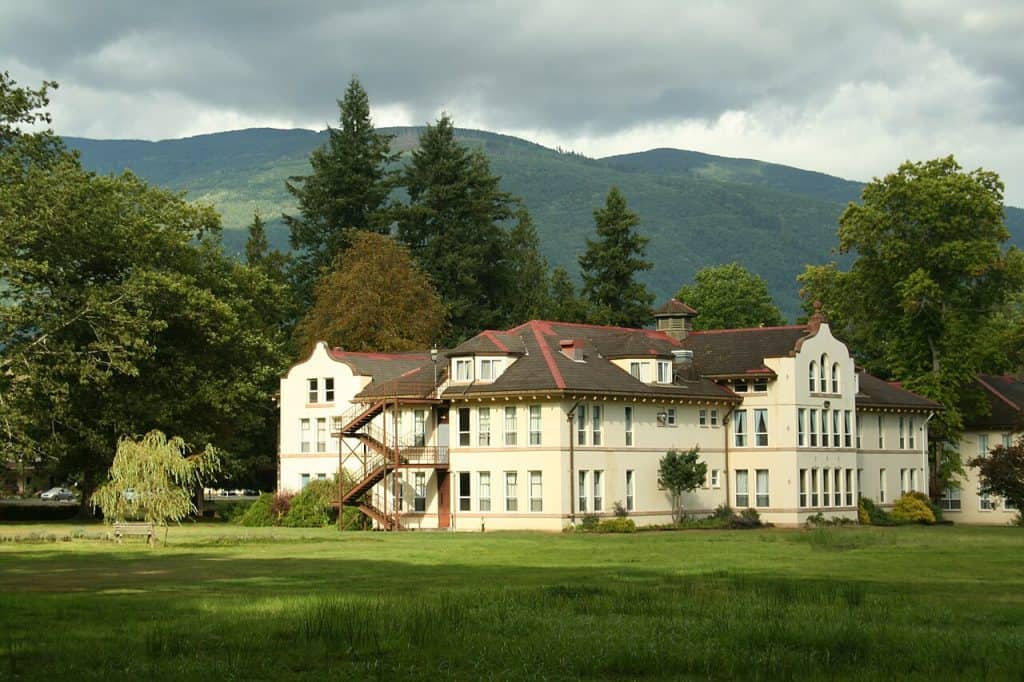
Northern State Hospital once operated as a sprawling, largely self-sufficient community in the foothills of the Cascade Mountains. Opened to patients in 1912, the institution included wards and treatment buildings as well as a farm, dairy, creamery, workshops, orchards, and other facilities. Patients helped keep many of those operations running until the hospital closed in 1973.
Much of the former campus has since been repurposed, but the surrounding property still holds reminders of what once stood there. At the Northern State Recreation Area, trails cross the former hospital farm and pass abandoned dairy buildings dating to the early 1920s. Their weathered roofs and empty openings rise above otherwise peaceful meadows, making the landscape feel caught somewhere between a public park and a place everyone suddenly walked away from.
The hospital’s history gives those ruins a weight that ordinary farm buildings would not have. A nearby cemetery contains the graves of former patients, many originally identified only by initials and burial numbers. It is a haunting reminder of how easily individual lives could disappear inside a massive institution. Visitors may explore designated areas during daylight, but entering the historic structures is prohibited—and from the outside, their dark windows are unsettling enough.
Monte Cristo Ghost Town, WA
©"Monte Cristo townsite looking northeast 2014-05-31" by Junkyardsparkle is licensed under CC0 1.0. - Original / License
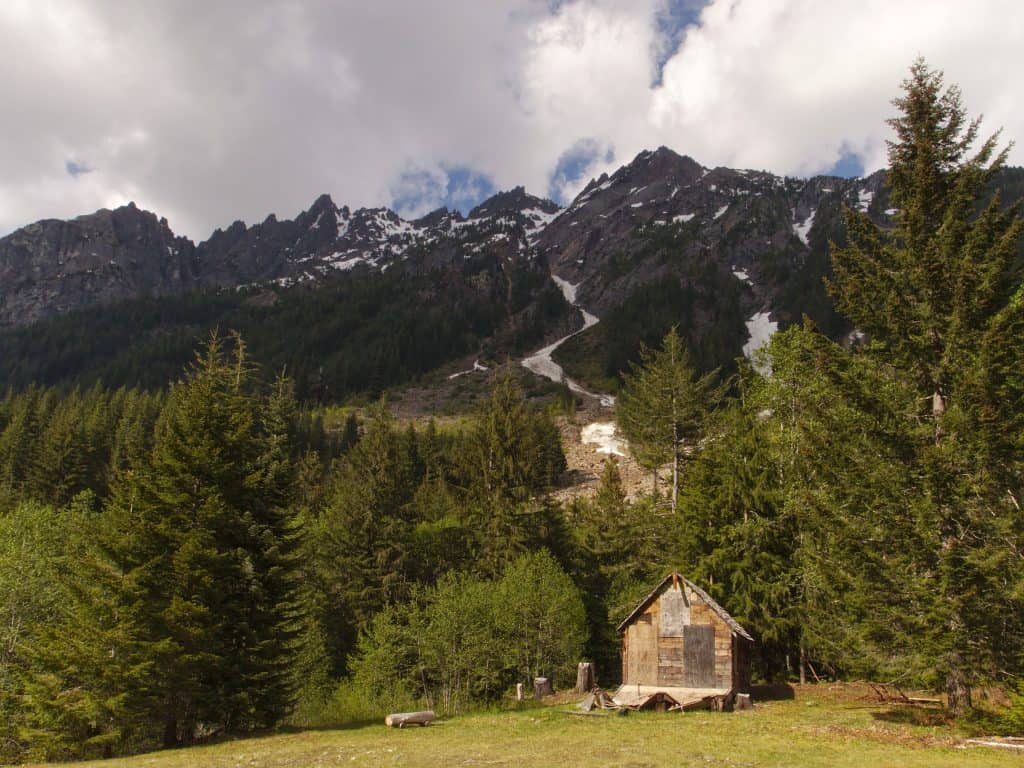
At the turn of the 1890s, the Rockefeller Syndicate poured millions into developing a silver and gold mining operation in the Cascade mountains in east Snohomish County. The village was confidently named after the Alexandre Dumas novel about buried treasure. In 1893, 200 claims had been established, and a train was running along the South Fork Sauk River. The grandfather of the 45th President, Frederick Trump, ran a hotel and a notorious brothel at the height of the mining boom.
As silver and gold ran out and flooding wreaked havoc with the rail line, the mining operation eventually shut down in 1907. In the following years, the town tried to reinvent itself as a resort community without success. Once the last lodge that kept the resort dream alive burned down in 1983, locals moved on.
The town’s ruins can be accessed via a trail that starts at the Barlow Pass off the Mountain Loop Highway and stretches for about eight miles. It was an old roadway used by the miners. All that remains are crumbling cabins, rusty machinery, and signs placed by a preservation group explaining what Rockefeller’s millions actually bought.
Fort Worden, Port Townsend, WA
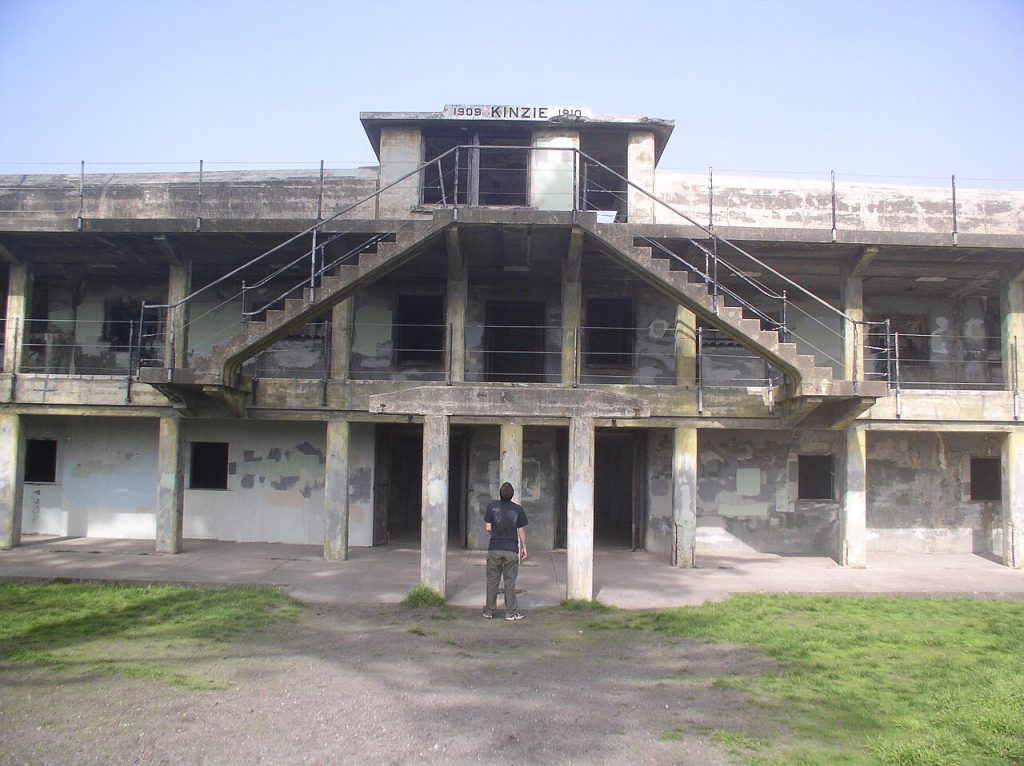
Fort Worden is not one abandoned building. It is an entire former military post overlooking the entrance to Puget Sound, complete with concrete gun batteries, ammunition rooms, narrow passageways, and empty platforms where enormous coastal weapons once stood. Construction began in the late 1890s, and the fort eventually held 41 artillery pieces intended to stop enemy ships from reaching the naval facilities farther inland.
The unsettling part is that its guns were never fired at an enemy. Generations of soldiers trained for an attack that never came, and advances in ships and aircraft eventually made the defenses obsolete. The Army permanently deactivated the fort in 1953, leaving behind hulking concrete structures built for a war that passed them by.
Fort Worden is now a popular state park, but the old batteries still feel strikingly disconnected from the beaches and mountain views surrounding them. Step inside, and the daylight quickly gives way to cold concrete chambers, blind corners, and corridors that seem to swallow every sound. Nothing supernatural needs to happen. The empty rooms already feel like they are waiting for orders that will never arrive.
The Witch’s Castle, Portland, OR
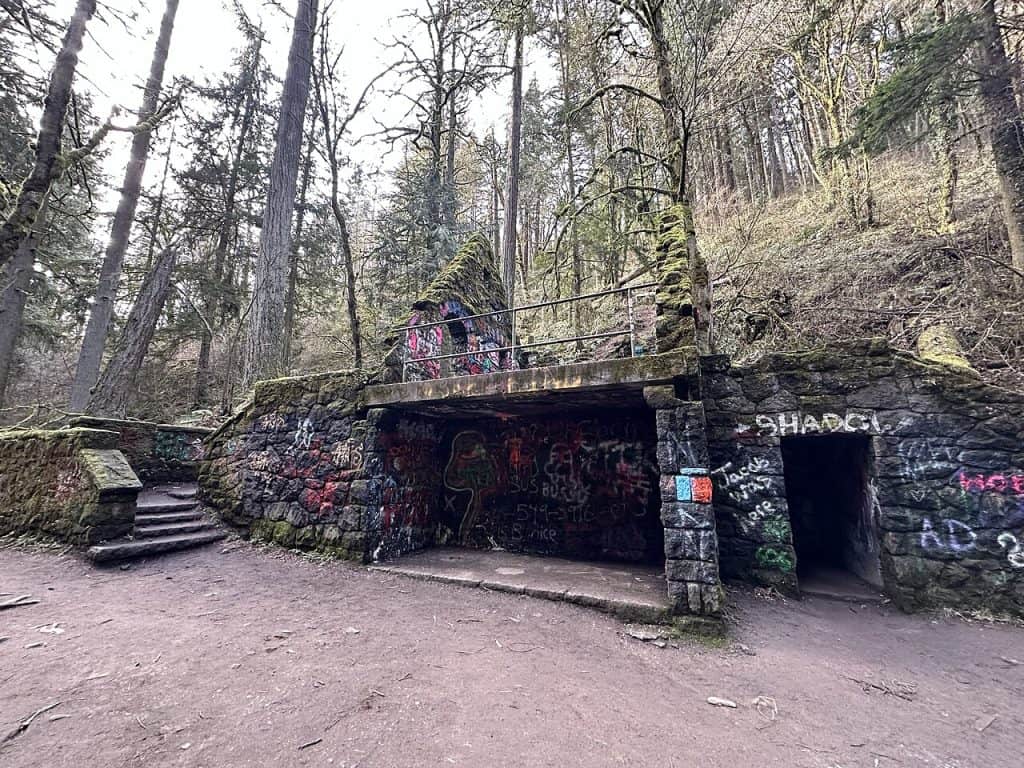
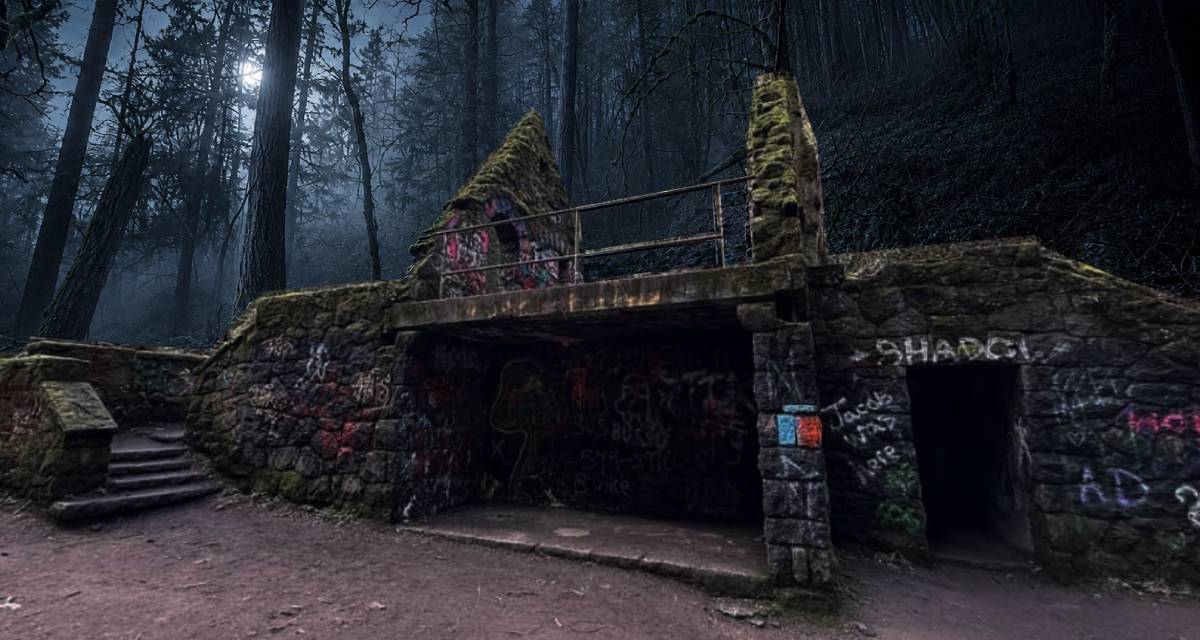
The stone ruins in Portland’s Forest Park are formally known as the Stone House. Nobody calls them that. The Witch’s Castle, as the locals call it, is a half-mile trek from the Upper Macleay Trailhead, down into a ravine along a creek. There, you will find a dilapidated stone structure with graffiti all over its moss-covered walls.
Technically, the Witch’s Castle is little more than an abandoned bathroom and ranger station built in the 1930s that sustained major damage during a storm in 1962. The land was owned by Danford Balch, who, after finding out his daughter had eloped against his will, shot and killed his newly married son-in-law on the Stark Street Ferry. Balch was the first man to be lawfully hanged in Portland.
The graffiti art done on the interior walls of the stone shell building consists mostly of occult symbolism, which is partly circumstance and partly people leaning into the atmosphere. The name was actually coined by local teenagers in the 1980s who discovered the ruins and decided it looked the part.
White Bluffs and Hanford, Eastern WA
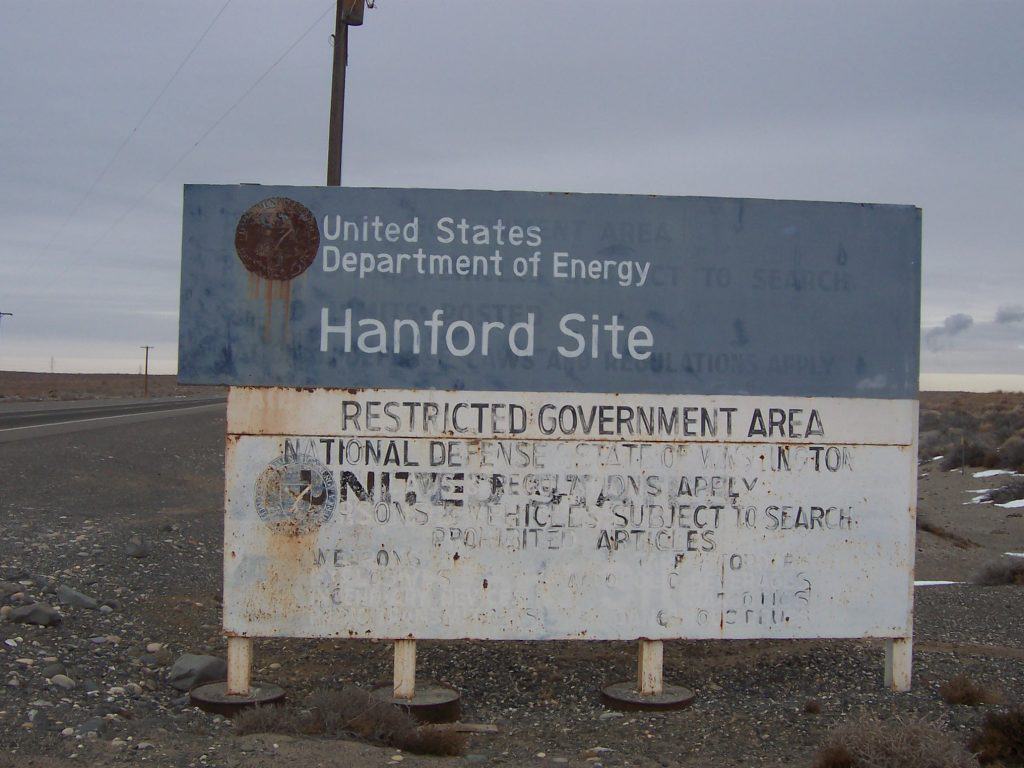
©"Hanford Site welcome" by Tobin is licensed under BY-SA 2.0. - Original / License
In 1943, residents of farming communities in White Bluffs and Hanford were given less than three months to vacate their homes. The government destroyed all the buildings, uprooted the orchards, and dug up corpses that were later relocated to Prosser. The government needed 586 square miles of desert land in eastern Washington. They used the land to build the plutonium plant. That plutonium would eventually be used in the Fat Man, the atomic bomb dropped in Nagasaki.
The B Reactor at Hanford was the first ever plutonium production reactor of its kind in the world. It is currently listed as a National Historic Landmark and available for free tours organized by the National Park Service, usually between April and September. The reactor is mostly intact, and the control panels are still in place. What makes this site disturbing is knowing that you’re inside the machine that manufactured plutonium for use in a nuclear bomb.
Satsop Nuclear Power Plant, Elma, WA
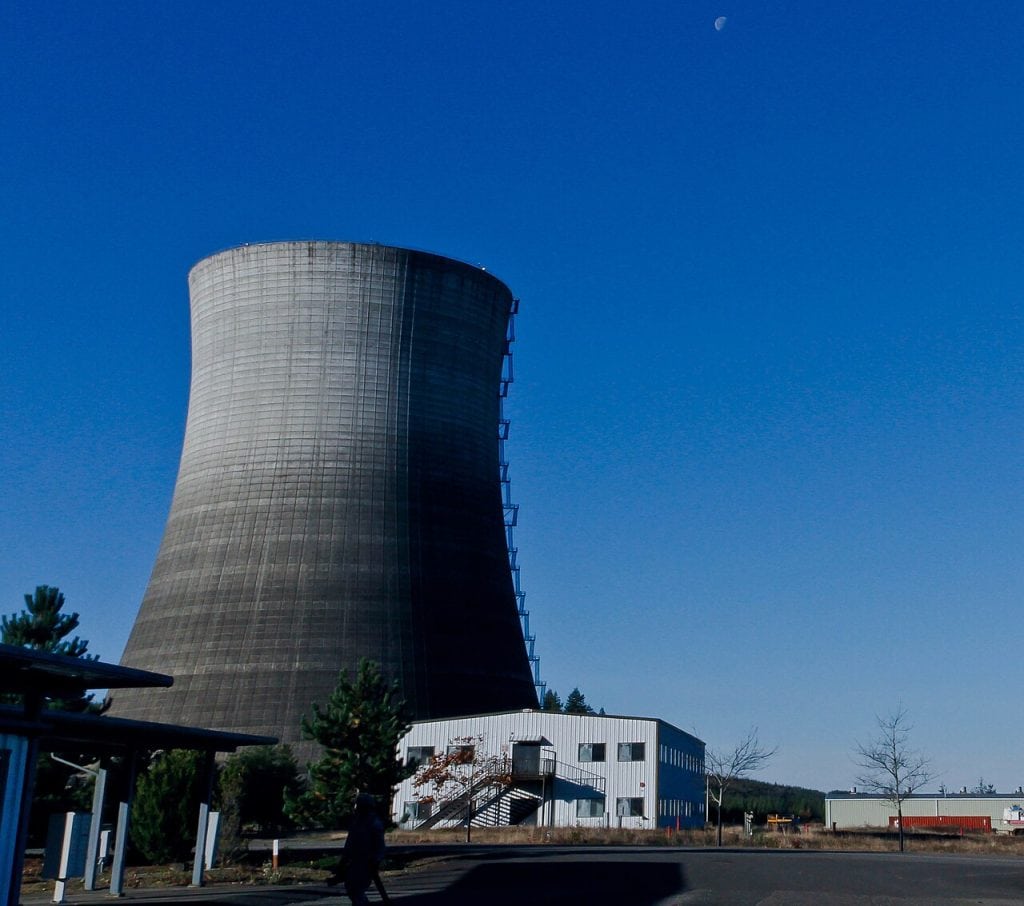
When driving from Aberdeen to Olympia, two gigantic concrete cooling towers emerge above the farms near Elma, in Grays Harbor County. Those towers were once part of America’s most ambitious nuclear power plant construction project. Five nuclear power plants were built by the Washington Public Power Supply System in the 1970s, often referred to in derisive shorthand as “Whoops.” Two of them were to be erected at the Satsop site.
The project was abandoned in 1982 due to massive cost overruns, resulting in one of the largest defaults of municipal bonds in the U.S. The plant was more than half finished when construction ceased. Neither the cooling towers nor the reactor containment domes were ever dismantled.
You can drive through what is now a business park in the middle of nowhere, while these two 500-foot-tall concrete cooling towers look down on you. The towers themselves, as well as other enclosed facilities, are off limits to the public, but you can approach them and take photos.
Govan, Lincoln County, WA
©Matt Ragen/Shutterstock.com
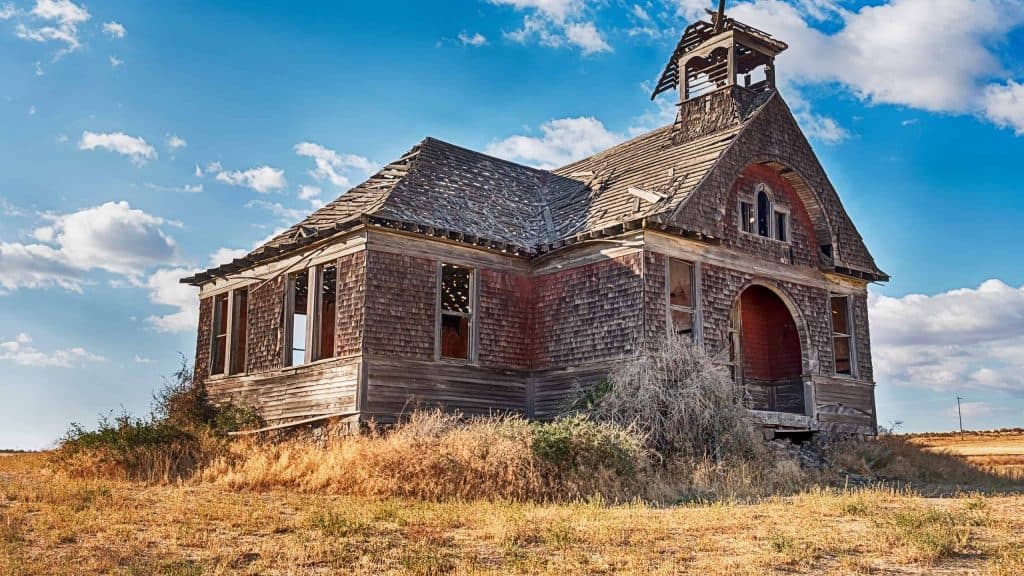
Govan sits off Highway 2, east of Wilbur in Lincoln County, and is now a shadow of its former self. A small cluster of dilapidated buildings is all that remains, dating back to when the Central Washington Railway came through in the late 1800s. The population peaked at several hundred, but when the railway moved on, the residents followed.
The ghost town has an eerie reputation due to a string of unsolved murders that took place in the early 1900s. There are no interpretive signs or guided tours. You pull off the highway, walk around in silence, and get back in your car. For some people, that’s more unsettling than the bunkers and the asylum put together.

