
Washington gets plenty of praise for its scenery. Its mountains, its beaches, its rainforest. These are all things that stick with you long after you leave. But if you know where to look, you’ll also come across some truly bizarre sights that will leave you wondering if you took a wrong turn somewhere.
A Stonehenge made of concrete in the middle of a desert or a giant troll holding a real-life Volkswagen Beetle. These are things that feel like they belong on a movie set, but they’re right here, sitting along Washington’s highways. Here are seven of the strangest things you can find while driving through Washington.
The Maryhill Stonehenge (Highway 14, Klickitat County)
©"Maryhill Stonehenge" by get directly down is licensed under BY 2.0. - Original / License
High up on a windy ridge on the eastern side of the Columbia River Gorge, off Highway 14, there’s a full-scale concrete replica of Stonehenge. It was built between 1918 and 1929 by Sam Hill, a road-building philanthropist and Quaker pacifist who visited the original monument in 1915. He decided to build his own version as a war memorial after hearing that ancient Britons had used it for human sacrifice.
The problem is that original Stonehenge was never a sacrificial site. Hill constructed an anti-war monument based on an incorrect premise. The altar stone’s position was determined by a University of California astronomer who happened to be nearby for a solar eclipse in June 1918. He deliberately oriented it to the astronomical horizon rather than the solstice sunrise of the original.
The Maryhill Stonehenge was listed in the National Register of Historic Places in 2021. It’s free to visit, and the scenery is worth the stop even without the Stonehenge.
The Teapot Dome Service Station (Zillah, off I-82)
©"Teapot Dome gas station, Zillah" by libraryofcongress is licensed under CC0 1.0. - Original / License
The Teapot Dome gas station was built by Jack Ainsworth in 1922 in Zillah, Washington. President Harding was in office at the time, and the Teapot Dome scandal had just broken out, involving the Secretary of the Interior, who had taken bribes over oil reserves in Wyoming.
The scandal took its name from a Wyoming rock formation shaped like a teapot. Ainsworth saw an opportunity to make a joke out of the whole ordeal and built his gas station, which was shaped like a teapot and happened to sell oil. He turned a building into a pun, and the pun turned into a business.
The building is 14 feet wide, with a conical roof and a metal handle. It has a concrete spout that doubles as a chimney for the wood stove inside. The building has moved twice: once in 1978 when Interstate 82 was built through the town, and again in 2012 when the city relocated it to First Avenue.
In 1985, the Teapot Dome Service Station was listed on the National Register of Historic Places, making it probably the only political joke the register has ever officially acknowledged. While you can no longer pump gas there, the building now functions as the Zillah visitor center and is certainly worth a visit.
Dick and Jane’s Spot (Ellensburg, off I-90)
©"Dick & Jane's Spot in Ellensburg, WA" by toki-doki is licensed under BY 2.0. - Original / License
At the corner of First Street and Pearl Street in Ellensburg, there is a building that has been accumulating outsider art since 1978. The artists Dick Elliott and Jane Orleman purchased it for only $18,000 when the city was planning to demolish it to build a parking lot. The two have continued decorating it ever since.
There’s a lot to unpack. The exterior is covered in over 10,000 bottle caps arranged in geometric patterns, hubcaps, painted cutouts, bottle trees, and telephone poles fashioned into faces with nails for hair. Works from more than 40 other Pacific Northwest artists are scattered throughout. Big Red, a piece in the front garden, is a topless figure made from a telephone pole, complete with reflectors for nipples.
Dick Elliott passed away in 2008, but Jane Orleman still lives in the building. While the structure isn’t open to visitors, the whole exterior is fully visible from the road. This may be one of the most densely packed and bizarre scenes you can actually witness from a car window in the entire state.
The Fremont Troll (Seattle, under the Aurora Bridge)
©"TROLL" by Antonio Campoy Ederra is licensed under BY 2.0. - Original / License
The Fremont Troll is an 18-foot concrete sculpture lurking under the Aurora Bridge. It was built in 1990 as a way to rehabilitate a neglected area, which had become a dumping ground. The Troll was designed by four local artists who won a community contest to fill the space.
Some tourists drive by it without stopping, but the scale is much more impressive in real life than in photographs. The troll is holding a real-life 1969 Volkswagen Beetle the same way you’d hold a toy. It sits at the intersection of Troll Avenue and N 36th Street. Parking is easier on weekday mornings, and admission is free.
La Merced (Anacortes, Highway 20)
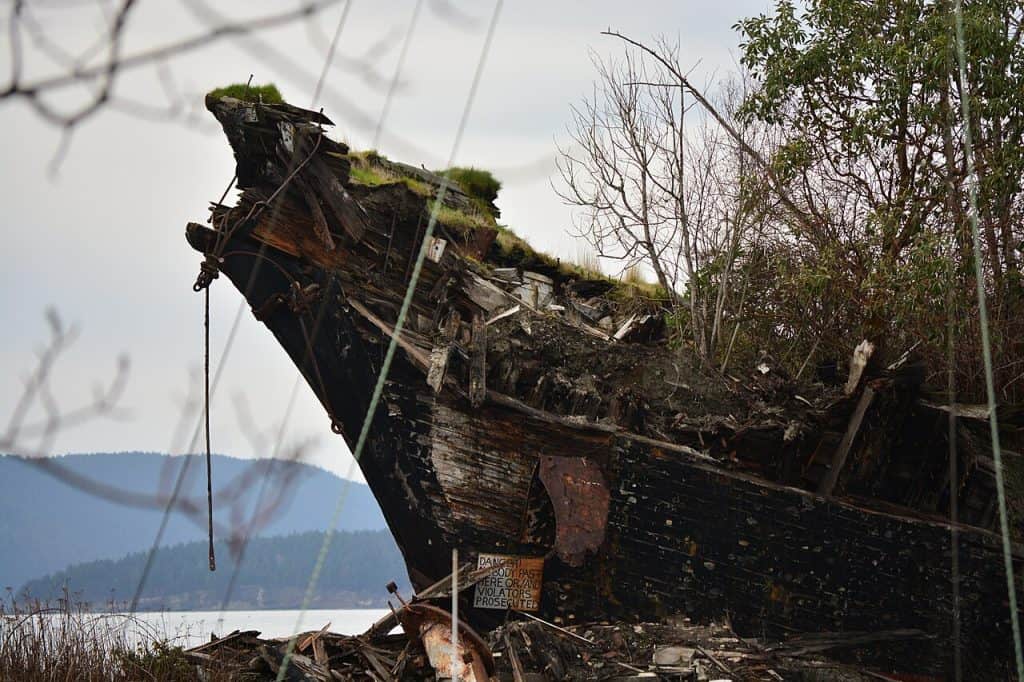
On the way to the San Juan Islands ferry terminal, just off Highway 20 on the edge of Fidalgo Island, sits a 232-foot wooden ship with a forest of trees growing out of it. We’re not talking about a few twigs. It’s an actual forest that can be seen from the roadside.
La Merced was built in 1917 in Benicia, California, during the shipbuilding boom of World War I. In the following years, it transported oil products for Standard Oil. It eventually ended up as a floating cannery in Alaska. By 1965, it was bought for scrap, its masts were chopped off, and the engines were removed.
In 1966, it was run aground at Lovric’s Sea-Craft Shipyard, its hull filled with dredged sand, and it was left to serve as a breakwater. The trees took root in the sand and have been growing ever since. The ship remains watertight, which is surprising given all it’s been through.
The site was included in the National Register of Historic Places in 1990, and can be seen clearly from the Guemes Channel Trail near the ferry terminal. Access to the hull itself is restricted, so seeing it from the trail is the only option, especially when the tide is low.
The Big Guy (Leavenworth, Highway 2)
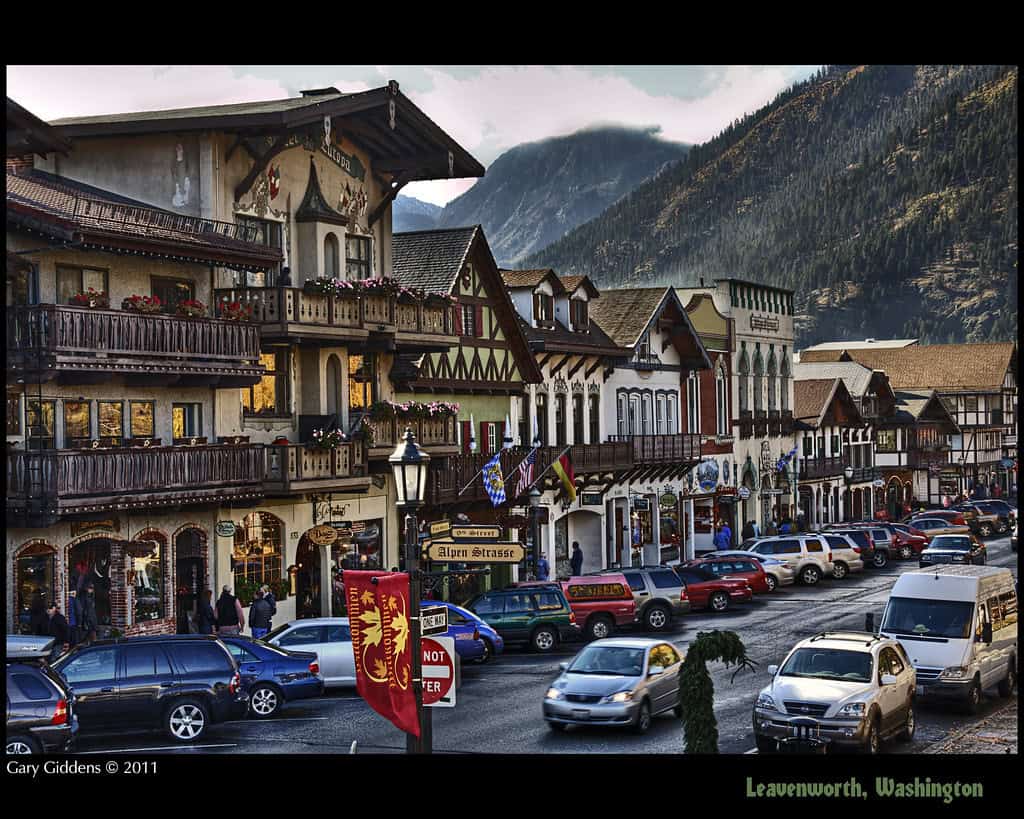
©"Leavenworth, Washington" by The Gidinski is licensed under BY 2.0. - Original / License
Leavenworth is unusual enough on its own. It’s a former logging town that reinvented itself in the mid-1960s as a Bavarian village and has maintained its Alpine image ever since. But near the western boundary of town, outside the Der Ritterhof Inn on Highway 2, there’s something Bavarian villages don’t typically have: a 25-foot-tall knight made of steel wearing armor and brandishing a battle ax and shield.
The knight is called “The Big Guy,” and it was built by Yakima artist Primo Villalobos using galvanized steel and scrap car parts. The sculpture has been standing guard outside the inn for nearly two decades. Der Ritterhof means “The Knight House” in German, so the branding is consistent. The statue can be seen from the highway when entering the town from the west, which is kind of its job.
The town’s Alpine conversion is worth at least a day, particularly in autumn, and the knight is free to see. Ninety seconds to pull over and have a look is all it takes.
The World’s Largest Egg (Winlock, off I-5)
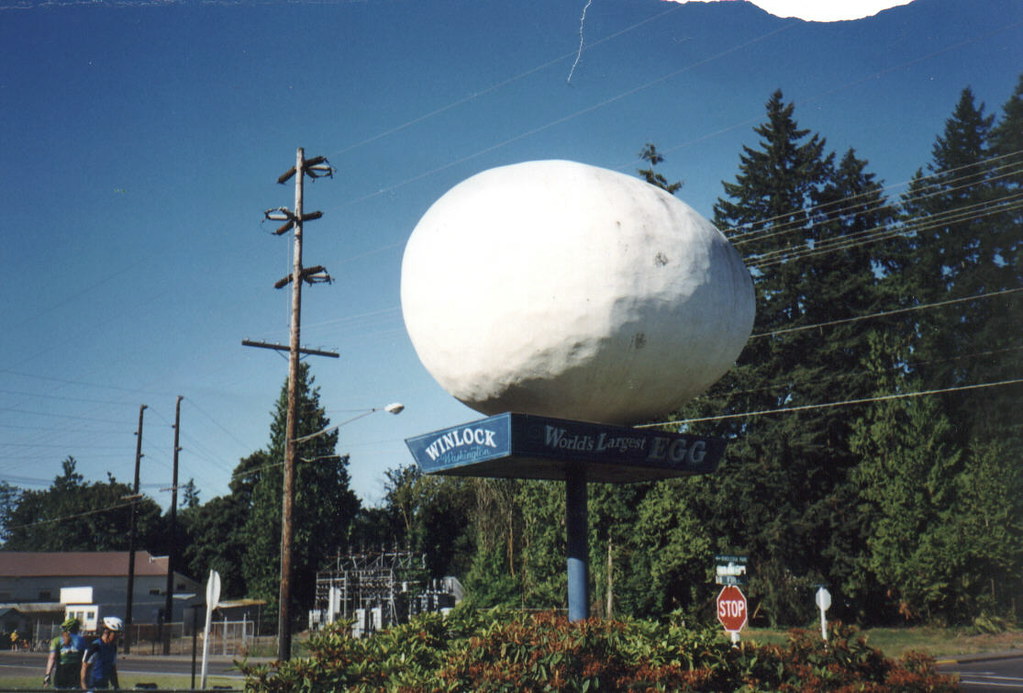
©"The egg at Winlock, WA. image taken 1999" by theslowlane is licensed under BY 2.0. - Original / License
Winlock has a giant egg. It’s been there since 1923, which means it has outlasted the industry it was supposed to honor. At that time, Winlock was the second-biggest egg-producing city in the USA, and Winlock eggs were shipped as far as New York and Hawaii, where sellers were contractually required to label them as such.
The egg was created for a parade celebrating the completion of the Pacific Highway Bridge over the Columbia River. It was such a hit that Winlock kept it on display after the parade ended. The first version was made of canvas on a wooden frame. It was replaced by plastic in 1944 and fiberglass in the 1960s.
The current egg was installed in 1990. It’s around 12 feet long and weighs 1,200 pounds. It sits on a 10-foot steel pedestal in a small park off Highway 505. The egg was repainted to look like the American flag after September 11th, and it has been defaced and restored multiple times since.
Ripley’s Believe It or Not certified the structure as the World’s Largest Egg in 1989. The egg industry in Winlock no longer exists, but the festival still runs every June.

