
Seattle spent much of the 1960s trying to prove it belonged on the major-league sports map. When the Dodgers and Giants moved from New York to California in 1958, it was another sign that professional sports were expanding west. Seattle soon had a major indoor venue of its own. The Seattle Center Coliseum was built for the 1962 World’s Fair, and the NBA awarded the city the SuperSonics in December 1966. The team began play the following year.
Baseball and football were a different problem. Seattle still needed a modern stadium big enough to attract MLB and NFL teams, and that kicked off more than a decade of proposals, elections, arguments, renderings, and occasionally some wonderfully strange ideas. More than 100 potential stadium sites were considered before the Kingdome finally rose south of downtown.
Some of the rejected concepts are almost more fun to look at than the building Seattle actually got. Here are five stadium and arena proposals that could have completely changed the city.
1. The Floating Waterfront Stadium

This one sounds like somebody designing a stadium after one too many drinks, but it was a real proposal. In 1963, a group of Seattle architects and contractors proposed putting a multipurpose stadium on Elliott Bay near Seattle Center, around the foot of Harrison Street. The stadium would have floated on concrete pontoons similar to those used for floating bridges. Concepts even included a ferry dock and a monorail connection to Seattle Center.
The waterfront stadium was one of several ideas competing for attention as King County tried to get a stadium financed. A 1966 stadium bond received a simple majority of the vote but failed because 60% approval was required. Two years later, voters finally approved a $40 million multipurpose stadium bond as part of the Forward Thrust package.
The delay mattered. The American League awarded Seattle an expansion franchise in December 1967, with the Seattle Pilots scheduled to begin play in 1969. Sick’s Stadium was expanded as a temporary home, but it was nowhere close to the long-term major-league facility the league wanted. The Pilots lasted one season before relocating to Milwaukee and becoming the Brewers. Seattle got another MLB team when the Mariners arrived in 1977, one year after the Kingdome finally opened.
2. A New Sonics Arena Outside Seattle

Seattle sports fans probably do not need another reason to reopen this wound, but here we are. In 2006, the Howard Schultz-led ownership group sold the SuperSonics and Seattle Storm for $350 million to an Oklahoma City-based group headed by Clay Bennett. Bennett initially said the Sonics could remain in the Seattle area if a satisfactory arena deal could be reached.
In February 2007, Bennett’s group pushed a plan for a new $530 million arena in Renton and sought at least $300 million in public financing. Other locations had also been discussed, including Bellevue. The timing was contentious because the Seattle Center Coliseum had already undergone a major reconstruction in the mid-1990s, reopening as KeyArena in 1995 after a project that cost roughly $104 million when the city’s work, team-funded improvements, and related construction were included.
Then Sonics minority owner Aubrey McClendon rather spectacularly undermined the public messaging when he told an Oklahoma newspaper, “We didn’t buy the team to keep it in Seattle.” The NBA fined him $250,000 for the comment. The arena deal never happened, and the Sonics moved to Oklahoma City after the 2007-08 season.
The story has another chapter now. Oklahoma City voters approved funding for a new arena in 2023, and agreements approved in 2025 commit the Thunder to the city through at least 2053. Meanwhile, the NBA Board of Governors voted in March 2026 to formally explore expansion to Seattle and Las Vegas. Seattle officials have declared the rebuilt Climate Pledge Arena ready for an NBA team. So after nearly two decades, the possibility of the Sonics returning is no longer just wishful thinking.
3. The Kent Sports Complex
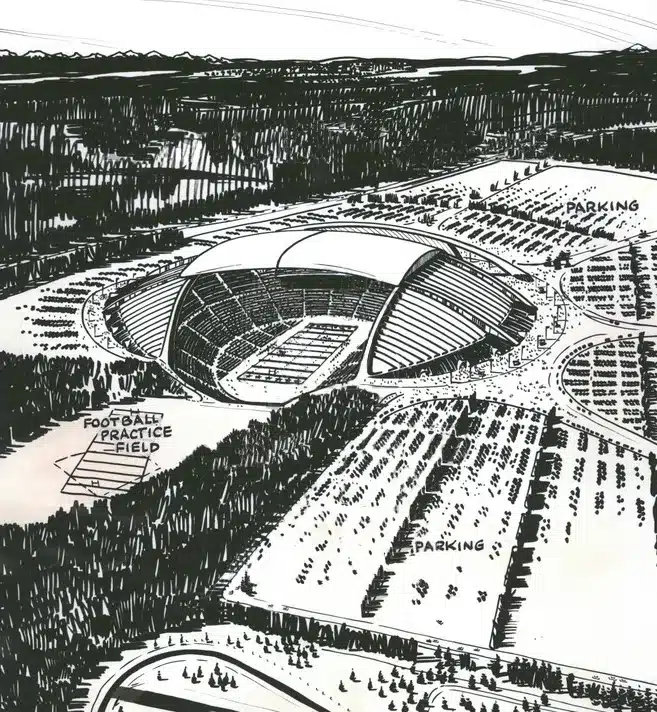
The proposed Kent project was much more ambitious than simply dropping a stadium in the suburbs. In 1963, Pacific Raceways Inc. proposed a privately financed sports complex in Kent that would have included a stadium, golf course, swimming pool, motel, cocktail lounge, bowling alley, and even a landing strip.
Basically, somebody looked at a stadium and decided it needed an entire vacation resort attached to it.
The project never got beyond the proposal stage as the region continued debating publicly financed stadium options and locations closer to Seattle. It is still a fascinating what-if. Had the Kent plan won out, the center of gravity for Seattle-area professional sports could have ended up well south of downtown instead of in the stadium district we know today.
4. The Seattle Center Dome
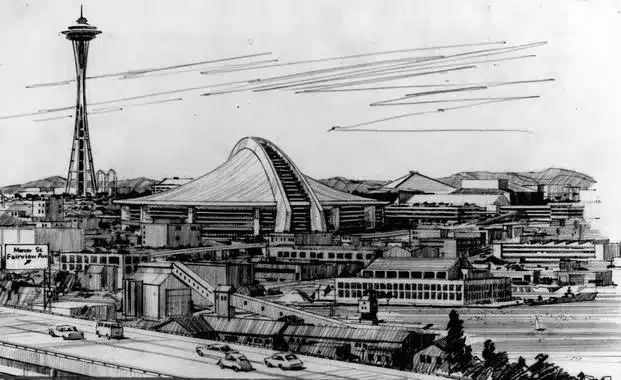
Seattle’s eventual stadium district feels so established today that it is strange to imagine the Mariners and Seahawks playing beside the Space Needle. For a while, though, Seattle Center was the leading option.
King County voters approved a $40 million stadium bond in February 1968, and the Washington State Stadium Commission endorsed Seattle Center as the preferred location that August. The site made obvious sense in some ways. Seattle Center already had major entertainment facilities, and planners envisioned new transportation connections to handle stadium crowds.
There was one fairly large problem: voters did not want it there. On May 19, 1970, voters rejected the Seattle Center stadium location. King County then returned to a site near King Street Station, adjacent to Pioneer Square and the International District. The County Council approved that location in late 1971, and groundbreaking followed on November 2, 1972 amid significant protests over the stadium’s impact on the surrounding neighborhood.
The Kingdome finally opened on March 27, 1976. Today, Lumen Field and T-Mobile Park anchor the sports district south of downtown, while Climate Pledge Arena occupies the old Coliseum site at Seattle Center. In 2026, Seattle also became an official candidate in the NBA’s expansion process, so the old idea of major-league basketball at Seattle Center may come full circle.
5. Seattle’s Other Wild Dome Concepts

If the first four proposals make Seattle’s stadium planning sound chaotic, we are barely scratching the surface. Between 1968 and 1972, officials considered more than 100 potential stadium sites before finally settling on the location that became the Kingdome.
The designs were just as varied. Some concepts were open-air. Others leaned heavily into the futuristic dome craze of the era. One particularly striking 1969 proposal from Harris & Reed used huge arches and a double-curved plywood shell for its roof, with preliminary plans calling for roughly 52,000 seats for baseball and 56,000 for football.
It is fun to imagine one of those structures surviving into modern Seattle, but there is a decent chance it would have met the same fate as the Kingdome, which was imploded in 2000 after only 24 years. Stadium design and the business of professional sports changed fast.
For perspective, Dodger Stadium opened in 1962 and is now the third-oldest active ballpark in Major League Baseball, behind only Fenway Park and Wrigley Field. A Seattle stadium built during the first round of proposals would be one of the oldest major sports venues in the country today. Instead, Seattle spent years drawing, debating, voting, and starting over before finally getting its dome.

